
The Pursuit of Abstraction
Published:
Introduction
I have spent most of my adult life moving deeper and deeper into abstraction. I studied mathematics, then computer science, then cognitive science, and eventually found myself working with deep neural networks, representations, datasets, algorithms, and machines that learn from patterns in data. Much of what I do now happens several layers removed from the physical world. And recently, while sitting beside a lake, I started thinking about how strange this trajectory actually is.
Human beings did not begin with abstractions. We began with our bodies. We touched things, moved things, carried things, broke things, built things, and learned that fire burns, that stone can cut, that wood floats, that water moves, that plants grow, and that animals run. We understood the world first through physical interaction. Our bodies were our first instruments of measurement, and the physical world provided the feedback.
From Embodiment to Abstraction
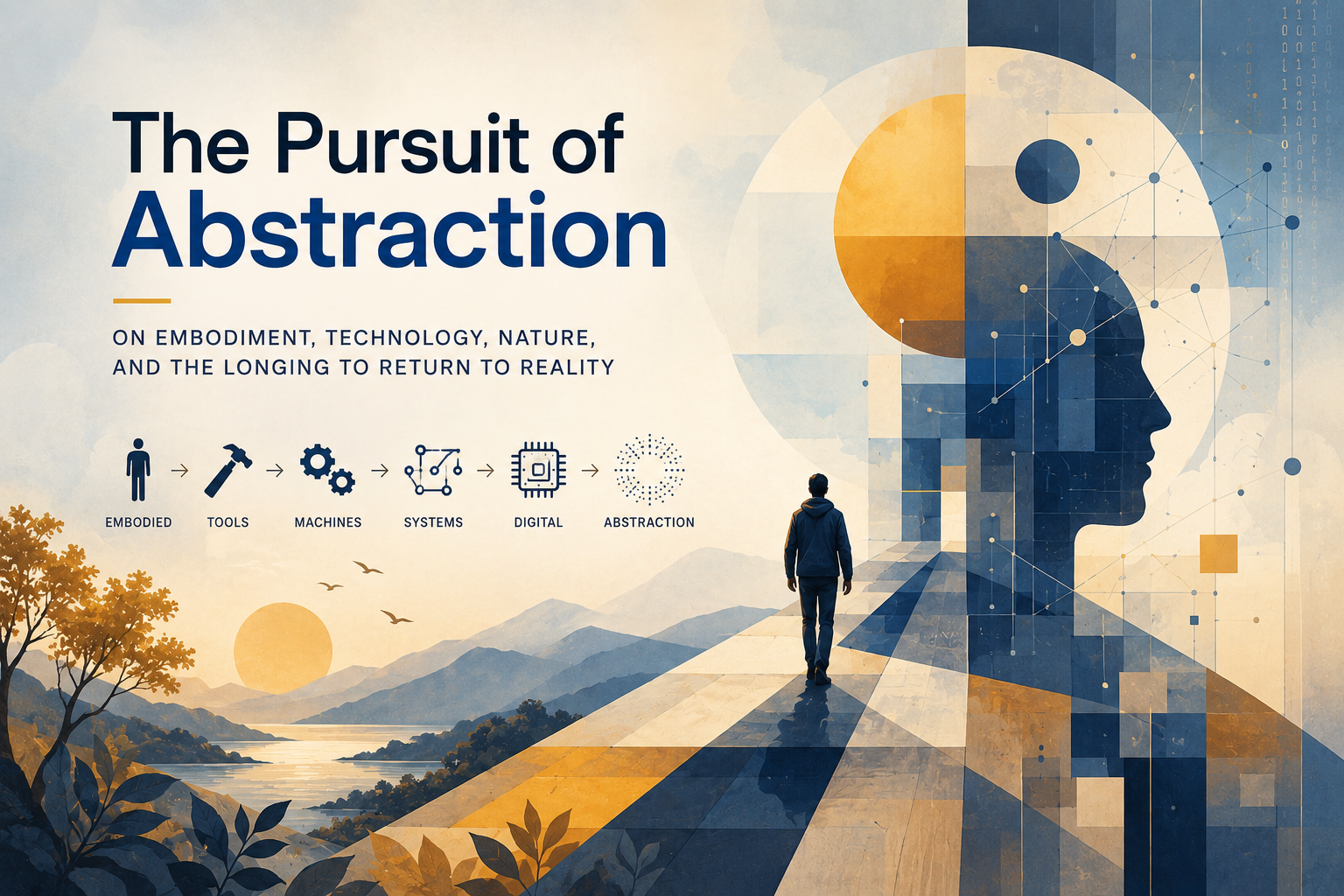
Then we started making tools. A stone became an extension of the hand. A spear extended the reach of the body. A wheel transformed how we moved things. Eventually, simple tools became machines, and machines became increasingly sophisticated systems of mechanical interaction. We progressively learned how to externalize our capabilities, first through simple physical tools, then through increasingly complex machinery.
And then something remarkable happened: we began abstracting the world.
We learned to represent physical quantities with symbols. We developed mathematics, writing, formal logic, mechanical computation, electrical systems, and eventually digital computers. With every technological transition, we became better at separating representation from physical reality. A number could represent a quantity without the quantity being present. A diagram could represent a machine without the machine being there. A dataset could represent a population without us meeting anyone in that population. A simulation could represent a physical system without us physically interacting with it.
Today, we live deep inside that abstraction. For many of us in knowledge work, our everyday existence consists largely of manipulating representations. We write code that operates on representations of things. We train models on representations of reality. We optimize functions, analyze distributions, construct abstractions, and increasingly build artificial systems that can themselves manipulate abstractions at astonishing scale.
The Power of Abstraction
This is one of the great achievements of human intelligence. Abstraction allows us to escape the immediate limitations of our physical environment. It allows us to reason about things we cannot directly see, touch, or experience. Through abstraction, we can think about galaxies without travelling to them, molecules without seeing them, populations without meeting every individual, and intelligence without necessarily reproducing the biological machinery that created it.
The Cost of Living in Abstraction
But I have started wondering whether there is also a cost to living too deeply in abstraction.
Perhaps there is a particular kind of fatigue that comes from spending too much of one's life several layers removed from the physical world. Abstraction is extraordinarily powerful, but it often creates distance between action and consequence. You can spend an entire day working on a model and still not know whether you have actually accomplished anything meaningful. You can spend weeks optimizing an algorithm, months writing a paper, or years building a scientific career, while the feedback from the world remains ambiguous, delayed, or mediated through institutions.
Physical reality behaves differently.
You plant something, and eventually it grows. You cook something, and you eat it. You build something, and you can hold it. You walk, and your body tells you that you have walked. You throw a stone into a lake, and you immediately see the ripples.
You don't need a computer vision model to tell you that the tree standing in front of you is a tree. You don't need a classification algorithm to determine that the sound coming from the branches is a bird. You don't need a mathematical model to establish that the water is moving. You don't need a neural network to recognize that the wind has changed. Your body already knows.
And perhaps that is part of what makes these experiences so powerful. They close the distance between action and consequence. You do something, and the world responds. There is something deeply grounding about that kind of feedback.
Remembering the Physical World
I think about this particularly because I grew up in rural Sierra Leone. There was a time when life was much more intimately connected to physical reality. We went to the farm. We planted rice. We harvested vegetables. We went fishing. Sometimes we hunted. We interacted directly with the land, the weather, the animals, the water, and the seasons. There was little abstraction between effort and consequence. You worked the land, and eventually the land gave something back. You went fishing, and you either caught something or you didn't. You planted something, and then you waited.
Your body participated directly in the process of living.
Then, over the years, I moved further and further away from that world: from physical work to education, from education to mathematics, from mathematics to computer science, from computer science to cognitive science, and from there into artificial intelligence and deep learning. Somewhere along that journey, I became increasingly comfortable manipulating representations of reality rather than reality itself.
There is nothing inherently wrong with this. In fact, I am fascinated by it. But perhaps the human being who spends most of his waking hours in abstraction eventually develops a strange longing for the primitive: for soil, water, trees, animals, walking, making things, growing things, and simply sitting somewhere and watching something happen without having to analyze it.
The Return to the Mundane
Maybe this explains something I have noticed in the way we portray extremely wealthy or successful people in popular culture. The billionaire has access to almost everything, yet he goes fishing. The successful executive retreats to a cabin in the woods. The scientist spends weekends gardening. The businessman goes sailing. The person who has spent his entire life manipulating complex systems suddenly wants to work with wood, soil, animals, water, or fire.
At first, it can seem strange. Why would someone who has everything want to spend an afternoon doing something so mundane?
Perhaps because the mundane is sometimes exactly what the abstract mind needs.
The fish doesn't care about your career. The tree doesn't care about your credentials. The soil doesn't care how many papers you have published. The water doesn't care about your productivity. These things simply exist. And when you interact with them, they give you something that abstraction often doesn't: immediate, embodied feedback.
Slowing Down
Perhaps this is why some of my most interesting thoughts have recently come to me when I slowed down. Not while reading a paper. Not while writing code. Not while training a model. But while walking. While sitting beside a lake. While being in a park. When nothing was demanding that I produce anything.
And perhaps there is something important in that.
We have spent thousands of years becoming extraordinarily good at abstracting the world. We built tools, then machines, then computers, then digital environments, and now artificial systems that can themselves manipulate abstractions at astonishing scale. But perhaps the next stage of maturity is not to move even further away from embodiment. Perhaps it is to learn how to move between the two worlds.
Finding the Balance
To be capable of thinking deeply in abstractions while remaining grounded in the physical world that gave rise to those abstractions in the first place. To build artificial intelligence without forgetting biological intelligence. To work with digital representations without losing contact with the things those representations represent. To spend the morning thinking about neural representations and the afternoon walking through a forest. To write code and then cook dinner. To analyze data and then plant something.
Perhaps that is not a retreat from progress. Perhaps it is a return to balance.
Because abstraction is one of humanity's greatest achievements. But we are still embodied creatures. And sometimes, after spending too long inside our own abstractions, we may simply need to return to the world that existed before them: to touch something, make something, grow something, walk somewhere, sit beside water, and remember that before we learned how to represent the world, we first learned how to inhabit it.
Leave a Comment